

Invoicing
made easy
for builders
Create professional invoices and send them to clients — right from your phone.
- Create invoices
in seconds - Send to clients
instantly - Track what is paid
and what is not - Keep your business
organised
The paperwork costs more than the paper
Billby can’t make a slow payer pay. It can get the invoice out while you’re still on the driveway, with the lines itemised and a due date on it — which is where most of the argument starts.
- 67%
- of businesses deal with late payments
- $17,500
- average outstanding balance
- 5h 20m
- a week spent on business admin
Built for the trade
Construction Invoice Template
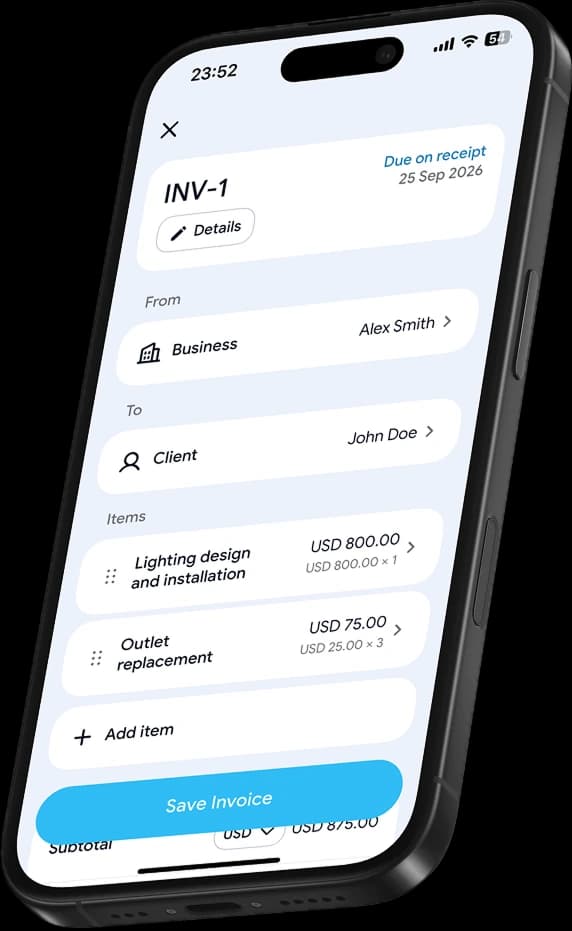
A construction invoice is more than a bill for completed work. It should clearly separate labor, building materials, equipment costs and project payments — so clients understand exactly what they’re paying for. Whether you’re a general contractor, independent builder or construction business owner, here’s a template built for construction projects and what belongs on one.
Add your business
Your construction company name, logo and contact details.
Add a client
Who you’re billing and the construction project’s location.
Add items
Each construction task, labor charge, material and equipment cost.
Set the details
Invoice number, issue date and payment due date.
Review totals
Subtotal, taxes, discounts and total amount due calculated for you.
Save or send
Download the PDF, print it, or send it directly to your client.
One of 20+ designs in the Billby app — itemized, professional and ready for your construction business’s branding.
What Should a Construction Invoice Include?
A professional construction invoice should clearly document the work completed, labor hours, building materials, equipment charges and agreed payment terms. Whether you’re invoicing for a residential renovation, new construction or a commercial building project, a detailed contractor invoice helps clients understand project costs and keeps your billing organized.
Here are eight essential details to include when creating a construction invoice.

Construction Business Details and Registration
Start your construction invoice with your company name, business address, phone number, email and any applicable contractor license or business registration number.
Licensing requirements vary by location and the type of construction work performed. Include relevant registration details or professional credentials where required to help clients identify your business and maintain accurate project records.
If you operate as an independent contractor, include the business and tax information required for invoicing in your jurisdiction.
Client Information and Construction Project Details
Include your client’s name, billing address and contact information. Clearly identify the construction project by adding the job site address, project name and a reference number where applicable.
For larger projects, you may also include the contract number, purchase order or billing period covered by the invoice.
These details are particularly useful when working with property developers, commercial clients, homeowners and general contractors managing multiple construction sites.
Construction Labor Costs and Hourly Rates
Break down construction labor charges by describing the work performed, hours worked, hourly rate and total labor cost.
For example, a construction invoice might show framing work as 12 hours at $65 per hour for $780 and drywall installation as 8 hours at $55 per hour for $440, giving a total labor charge of $1,220.
For projects involving multiple trades, consider listing carpentry, masonry, painting and installation work as separate line items.
An itemized labor breakdown makes it easier for clients to understand how construction costs were calculated and compare charges with the agreed scope of work.
Building Materials and Supplies
List construction materials individually, including descriptions, quantities, unit prices and total costs.
Depending on the project, your invoice might include lumber, concrete, drywall, insulation, roofing materials, fasteners, paint or electrical supplies.
For example, you could list 25 sheets of drywall at $18 each, giving a material cost of $450.
Clearly separating building materials from labor charges provides a transparent record of project expenses and helps clients understand where their construction budget is being spent.
Construction Equipment and Additional Expenses
If your project requires rented machinery, specialized tools or additional services, include these expenses as separate invoice items.
Common construction equipment charges may include excavator rental, scaffolding, concrete mixers, power tools and temporary site equipment.
You may also need to invoice for waste disposal, material delivery, transportation or subcontractor services.
Specify whether equipment costs are charged hourly, daily or as a fixed amount. Itemizing these expenses helps avoid confusion about charges beyond standard construction labor and materials.
Progress Payments and Construction Milestones
Large construction projects are often billed in stages rather than through a single final invoice.
If your contract includes progress payments, clearly identify the project milestone or billing period covered by each invoice.
For example, a residential construction project might have separate invoices for foundation completion, structural framing, roofing and final finishing work.
Include the amount due for the current stage and reference any previously paid deposits or installments where relevant.
For percentage-of-completion billing, specify the agreed milestone or completed portion of the project. Keep any required supporting progress documentation separate from the invoice.
This helps clients understand which work has been billed and how each payment relates to the overall construction contract.
Change Orders, Additional Work and Retainage
Construction projects sometimes involve changes to the original scope of work, additional materials or unexpected site conditions.
If the client approves extra work, document the additional charges separately and reference the relevant change order or agreement.
For example, unexpected foundation repairs, additional electrical work or upgraded building materials may require separate invoice items.
Where applicable, include any contractual retainage or retention amount withheld until a specified project milestone or completion.
Clearly identify the retained amount and the current payment due. The treatment of retainage and change orders depends on your contract and local requirements.
Construction Invoice Payment Terms and Due Date
Complete your construction invoice with a unique invoice number, issue date, payment due date, applicable taxes and total amount due.
Clearly state the agreed payment terms, whether payment is required upon completion, after an approved project milestone, or within a specified period such as Net 14 or Net 30.
If a deposit has already been paid, show how it affects the remaining balance.
Include accepted payment methods and relevant payment instructions so clients know when and how to pay.
For larger construction projects, reference the applicable contract payment terms and any supporting documentation required before payment can be processed.
Billby invoice maker app
The stage is signed off. Send the invoice.
Create, send and manage construction invoices right from your phone. Keep your clients, their projects and every stage of the build organized — on site or back at the office.
- Create invoices in seconds
- Download as PDF
- Share with clients
- Works offline
Construction Invoice FAQs
How do I create a construction invoice?
Use Billby to create professional construction invoices directly from your phone. Add your business and client details, identify the construction project, itemize labor, materials and equipment charges, and set your payment terms. Choose a professional invoice template and generate a PDF invoice ready to send to your client.
What should a construction invoice include?
A construction invoice should include your business details, applicable contractor license or registration number, client information, project address, invoice number, issue date and payment due date. It should also provide an itemized breakdown of construction labor, building materials, equipment expenses, applicable taxes and the total amount due. Include relevant contract or milestone references where appropriate.
How do contractors calculate labor and material costs?
Contractors typically calculate labor costs using the hours worked multiplied by the agreed hourly rate, or a fixed price for specific construction tasks. Material costs are calculated using the quantity of each item multiplied by its unit price. List labor and materials separately to give clients a clear breakdown of construction expenses.
Can I invoice for construction project milestones?
Yes. Many construction contracts use progress billing, allowing contractors to invoice clients after completing agreed project stages. For example, you might issue separate invoices for foundation work, framing, roofing and final finishing. Each invoice should identify the relevant milestone, work completed, amount due and any previously paid installments.
Should construction invoices include equipment rental costs?
Yes, if equipment rental is chargeable under your agreement. List machinery, scaffolding, specialized tools and other rented equipment separately from labor and building materials. Include the rental period, applicable rate and total charge so clients understand how equipment expenses contribute to the project cost.
How do I invoice for additional construction work?
When a client approves work outside the original contract, add the extra labor, materials or services as separate invoice items. Reference the approved change order or written agreement where applicable. This helps distinguish additional construction work from the original project scope and keeps billing transparent.
Do contractors charge tax on labor and building materials?
Tax requirements depend on your location, business tax status and the type of construction service provided. Construction labor, building materials and equipment charges may be subject to different tax rules. Check the applicable requirements with your local tax authority or accountant before setting invoice tax rates.
Can I create and send construction invoices from my phone?
Yes. With the Billby invoice maker app, you can create, customize and send professional construction invoices directly from your phone. Save client details, itemize labor and building materials, choose from professional invoice templates and manage your invoices whether you’re working on a construction site or in the office.
Explore more
Templates for other industries
Need an invoice for a different type of work? Browse more professional invoice templates in the Billby app.