

Invoicing
made easy
for electricians
Create professional invoices and send them to clients — right from your phone.
- Create invoices
in seconds - Send to clients
instantly - Track what is paid
and what is not - Keep your business
organised
The paperwork costs more than the paper
Billby can’t make a slow payer pay. It can get the invoice out while you’re still on the driveway, with the lines itemised and a due date on it — which is where most of the argument starts.
- 67%
- of businesses deal with late payments
- $17,500
- average outstanding balance
- 5h 20m
- a week spent on business admin
Built for the trade
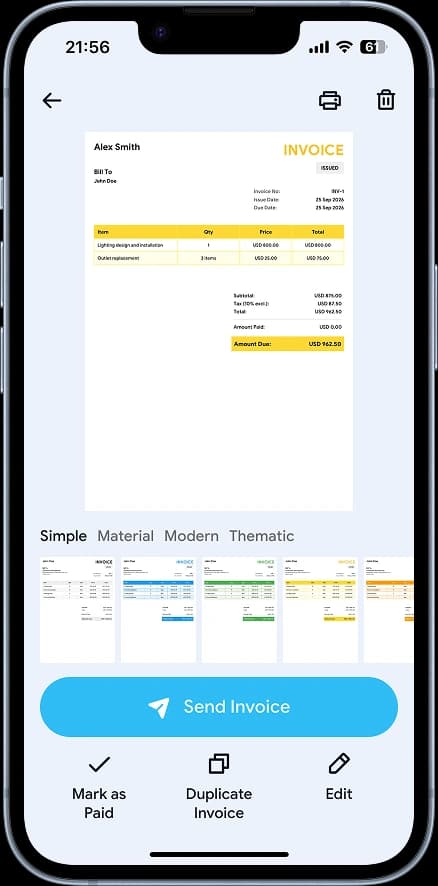
Electrical Invoice Template
An electrical invoice carries more than a price. It has to show your licence, reference the certificate you issued and separate testing from the work itself — because the person paying may be a landlord, an agent or an insurer who needs all three. Here is a template built for that, and what belongs on one.
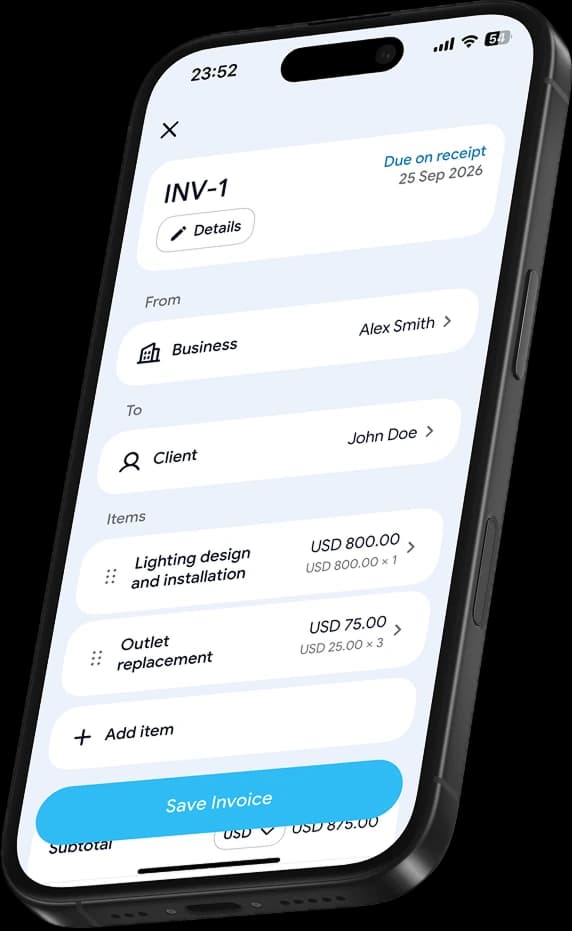
Add your business
Your business name, logo and contact details.
Add a client
Who the invoice is for, and where the work was done.
Add items
Each line with its quantity, unit and price.
Set the details
Invoice number, issue date and the date it falls due.
Review totals
Subtotal, tax, discounts and amount due are worked out for you.
Save or send
Download the PDF, print it, or send it straight to the client.
One of 20+ designs in the Billby app — headed, itemised and ready for your logo.
What Should an Electrical Invoice Include?
A professional electrical invoice should clearly document the work completed, labour costs, materials used and payment terms. Whether you’re billing for an emergency electrical repair, a residential installation or a commercial electrical project, a detailed invoice helps customers understand exactly what they’re paying for.
Here are eight essential details to include when creating an electrical invoice.

Electrical Business Details and Licence Number
Start your electrician invoice with your business name, address, phone number, email and any applicable electrical contractor licence or registration number.
Licensing requirements vary by location and type of electrical work. Include relevant professional registration or certification details where required to help customers identify your business and maintain accurate records.
Customer Information and Job Address
Include your customer’s name, billing address and contact details. If the electrical work was completed at a different location, list the service address separately.
This is particularly useful when invoicing landlords, property managers, construction companies and commercial clients managing multiple properties or electrical installations.
Electrical Call-Out and Inspection Fees
If your business charges a call-out, diagnostic or electrical inspection fee, list it separately on your invoice.
Explain what the fee covers, such as an initial site visit, fault diagnosis or electrical safety inspection. Specify whether any diagnostic time is included or whether additional labour is charged separately.
Electrical Labour Costs and Hourly Rates
Break down electrical labour charges by showing the type of work performed, hours worked, hourly rate and total labour cost.
For example, an electrician invoice might show electrical fault diagnosis as 1 hour at $85 and socket installation as 2 hours at $75 for $150, giving total labour of $235 for 3 hours.
For larger electrical projects, consider separating installation, testing and repair work into individual line items. This makes your electrical invoice easier to review and helps customers understand how labour costs were calculated.
Electrical Parts, Equipment and Materials
List electrical materials and replacement parts individually, including descriptions, quantities, unit prices and total costs.
Depending on the job, your invoice might include circuit breakers, electrical cables, switches, sockets, lighting fixtures or distribution board components.
An itemized electrical invoice provides a clear record of the materials installed and makes it easier for customers to distinguish equipment costs from labour charges.
Emergency Electrical and After-Hours Charges
If you offer emergency electrician services, clearly identify additional charges for urgent call-outs, evenings, weekends or public holidays.
Show emergency service fees and premium labour rates separately from standard electrical work. Where applicable, specify any minimum call-out charge or additional travel fee.
Clearly documenting these charges helps customers understand the cost of emergency electrical repairs.
Electrical Testing, Certification and Workmanship Warranty
Include details of any electrical testing, inspection or certification performed as part of the job.
Where applicable, reference relevant electrical safety certificates, inspection reports or compliance documentation provided to the customer. The invoice itself does not replace any legally required certification.
If your electrical work includes a workmanship warranty, specify its duration and coverage. Distinguish between your workmanship guarantee and any manufacturer’s warranty covering installed electrical equipment.
Electrical Invoice Payment Terms and Due Date
Complete your electrical invoice with the invoice number, issue date, payment due date, applicable taxes and total amount due.
Clearly state the agreed payment terms, whether payment is due upon completion or within a specified period, such as Net 14 or Net 30.
Include your accepted payment methods and relevant payment instructions so customers know how and when to pay for the electrical services provided.
Billby invoice maker app
Finish the electrical work. Send the invoice.
Create, send and manage electrical invoices right from your phone. Keep your customers, invoices and payment information organized, wherever the job takes you.
- Create invoices in seconds
- Download as PDF
- Share with clients
- Works offline
Electrical Invoice FAQs
How do I create an electrical invoice?
Use Billby to create professional electrical invoices directly from your phone. Add your business and customer details, describe the electrical work completed, itemize labour and materials, and set your payment terms. Choose an invoice template and generate a professional PDF invoice ready to send to your client.
What should an electrical invoice include?
An electrical invoice should include your business details, applicable electrical contractor licence number, customer information, job address, invoice number, issue date and payment due date. Include an itemized breakdown of electrical labour, materials, call-out fees, applicable taxes and the total amount due. Add any relevant electrical certification or warranty information.
Should electricians charge separately for labour and materials?
Separating electrical labour and material costs makes your invoices easier to understand. List the hours worked and hourly rate for each service, then itemize electrical components such as wiring, circuit breakers, switches and sockets with their quantities and prices. This provides customers with a clear breakdown of the work performed.
Do electricians charge tax on labour and materials?
Tax requirements for electrical services depend on your location, business tax status and the type of work performed. Electrical labour and materials may be subject to different tax rules. Check the applicable requirements with your local tax authority or accountant before setting your invoice tax rate.
When should an electrical invoice be paid?
Payment terms depend on your agreement with the customer and the type of electrical project. Some electricians request payment upon completion, while others offer payment terms such as Net 14 or Net 30. Include a clear payment due date, accepted payment methods and any agreed payment conditions on every invoice.
Should an electrical invoice include inspection and certification details?
If your electrical work involves testing, inspections or certification, include relevant information on your invoice. You can reference electrical safety certificates, inspection reports or compliance documents provided to the customer. An invoice does not replace any legally required electrical certification.
Can I create and send electrical invoices from my phone?
Yes. With the Billby invoice maker app, you can create, customize and send professional electrical invoices directly from your phone. Save customer details, add electrical labour and materials, choose professional invoice templates and manage your invoices wherever your next job takes you.